Pages

Tuesday, July 31, 2012

Slaughterhouse-Five

Kurt Vonnegut
Slaughterhouse-Five - $5.70
1969

Kurt Vonnegut was an american novelist, satirist and POW in World War 2. He wrote numerous novels, short story collections, essays and screenplays. He is best known for his novel Slaughterhouse-Five which is number 18 in the Modern Library’s 100 Best Novels.

So what is Slaughterhouse-Five? Is it a dark comedy, an anti war novel, a metafiction, or science fiction? Well, it is all these things, it is complex in structure yet simple to understand and a pleasure to read. You have to go along for the ride with Vonnegut. He has a way of finding humor in everything, even death; so much so that his writings are called Gallows Humor.

There is a recurring reference to death in the book, “So it goes.” Every time someone dies or there is any mention of death “So it goes” appears. This leads to some funny moments when he references inanimate objects and says “So it goes.”

“The Champagne was dead. So it goes.”
The novel begins with the narrator trying to write a war novel and quickly changes to science fiction. The narrator could be Vonnegut himself but that can also be a fiction. The story begins as a metafiction about writing a novel and ends with time travelling aliens. So it goes. For more on metafiction see my post here.
“All this happened, more or less. The war parts anyway, are pretty much true. One guy I knew really was shot in Dresden for taking a teapot that wasn't his. Another guy I knew really did threaten to have his personal enemies killed by hired gunmen after the war. And so on. I've changed all the names.”

Every person that I have recommended this novel to loves it. The story jumps around a lot but never to the point of being confusing. The humor comes at unexpected points that will keep you reading. This book has also been subject to numerous attempts at censorship, including a supreme court case specifically mentioning Slaughterhouse-Five.

Kurt Vonnegut was also quite popular appearing in many cameo roles in films, including a few of his novels adaptations. Slaughterhouse-Five was made into a film in 1972. Guillermo Del Toro has shown interest in remaking the 1972 movie adaptation. The novel is one of Vonnegut’s best work and an American masterpiece. This is modern literature at its best.

We have a new Facebook Page, check it out and Like us to keep up to date on the latest Kindle Literature news. You can share this post or any others on your social media of choice and bookmark the site for future post. You can also grab the RSS feed or try a   free 2 week trial*  on your kindle to have the posts delivered directly to you. Follow me on twitter @seframos. Happy Reading.

Monday, July 30, 2012

Animal Farm

George Orwell
Animal Farm - $7.92
1945

Animal Farm is a novella first published in 1945. This story is included in many best novel list including Time Magazine's top 100, number 31 in the Modern Library’s list of 100 best fiction, and is included in the encyclopedia of Great Books of the Western World.

Novella n. A short novel or long short story.
Animal Farm has also been banned in many countries around the world for numerous reasons, including anthropomorphism and anti-government propaganda. The story gives many human traits to the animals that revolt to take over the farm and is a critique of communism.
Anthropomorphism n. Attribution of human motivation, characteristics, or behavior to inanimate objects, animals, or natural phenomena.
Animal Farm is an allegory for the communist revolution in the Soviet Union. Orwell is using the story in Animal Farm to critique the communist socialist regime that had taken control of the Soviet Union.
Allegory n. A representation of an abstract or spiritual meaning through concrete or material forms; figurative treatment of one subject under the guise of another.
It definitely helps to know some of the history of the Soviet Union and the rise and fall of communism to understand what Orwell is trying to say. The story is very entertaining but when you understand the satire being used you begin to understand the story and the moral in a more obvious way.
Satire n. The use of irony, sarcasm, ridicule, or the like, in exposing,denouncing, or deriding vice, folly, etc.
Because the story is teaching a moral or lesson that can be learned from the communism in the Soviet Union it can be considered a fable.
Fable n. A short story, typically with animals as characters, conveying a moral.
Orwell used many literary devices to criticize the communism in the Soviet Union and had a hard time finding a publisher. Since the Soviet Union was allied with Britain during WWII, the British publishers did not want to print a book that was critical of the Soviet Union.

Animal Farm is an allegory that follows the rise and fall of communism in the Soviet Union. The story uses the farm animals to tell the story of how the communist revolution came about and how it was corrupted by the leaders. The story is presented as being far fetched by the use of animals to represent the uprising of the people. The use of animals was also considered very offensive. Orwell uses pigs to represent the leaders of the revolution.

Animal Farm is very entertaining even though it is based on true events. Orwell does a great job with the satire to make this a must read for anyone interested in reading the classics. This book is taught in many high schools and universities. Their are two different film versions of the book. Download a free sample and see why everyone that reads this book agrees that it is one of the best novels ever written.

We have a new Facebook Page, check it out and Like us to keep up with the latest news about Kindle Literature. Please share this post or any others on your social media of choice and bookmark the site for future post. You can also grab the RSS feed or try a   free 2 week trial*  on your Kindle to have the posts delivered directly to you. Follow me on twitter @seframos. Happy Reading.

Monday, July 23, 2012

The Los Angeles Diaries

James Brown
The Los Angeles Diaries: A Memoir - $9.99
2003

James Brown is an American novelist and English professor living in California. The Los Angeles Diaries was first published in 2003 and received many awards. The book is taught in many universities across the US, including Harvard. I first read this book as a freshman in college and could not put it down. I spent the next three years trying to take a class by Professor Brown and finally managed to in my last quarter as an undergrad. He is a natural storyteller that can make you laugh and cry at the same time. The Los Angeles Diaries is a memoir about his life as an addict. The difference between a memoir and an autobiography is that a memoir covers only a certain time period or events where an autobiography covers most of the authors life. This book focuses on events surrounding addiction in his family.

The stories major themes are family, drugs and addiction. This may seem like a very depressing book but the story is about perseverance. When the professor found out I had read his book he asked me what I thought. The only word that came to mind was Powerful. The story telling is powerful, the themes are powerful and the lessons learned are powerful.

James Brown is an intimidating figure due to his growing up in a dysfunctional family where his siblings committed suicide to his years as a drug addict all while trying to be a writer and teacher in a university. Brown revisits the idea that he is a fraud as a professor in his memoir, because of his personal demons, again and again. He is very self deprecating in person but he is a great story teller. In class he would tell us stories that were not included in his books. His class was one of the most memorable that I have ever had. He writes about being self conscious as a professor but this makes him a great professor. He tries very hard to help each of his students to learn and improve in their writing.

James Brown is almost a contradiction. He is a very successful writer and has overcome personal addiction and tragedy in his family, yet he is one of the nicest people to talk to. He appreciates life and goes out of his way to form personal connections with his students. Even though he is no longer a drug user, addiction is still an overwhelming theme in his writings and in conversation. He says regularly that he is lucky to be alive.

The Los Angeles Diaries is a wonderful memoir about perseverance and coming to terms with life’s tragedies. The book has just been reissued to coincide with his new book, This River. This River is a continuation from where The Los Angeles Diaries leaves off. I am looking forward to reading This River soon and will post a review when I finish.

Authors! we are currently accepting submissions for review in the following categories: general fiction, non-fiction and literary fiction. Books must be available in Kindle or ePub format and priced between $0.00 and $9.99. Please email queries to kindleliterature@yahoo.com

We have a new Facebook Page, check it out and Like us to keep up with the latest news about Kindle Literature. Please share this post or any others on your social media of choice and bookmark the site for future post. You can also grab the RSS feed or try a   free 2 week trial*  on your Kindle to have the posts delivered directly to you. Follow me on twitter @seframos. Happy Reading.

Friday, July 20, 2012

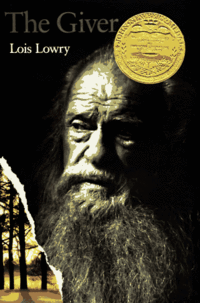
The Giver

Lois Lowry
The Giver - $5.59
1993

Do not read this book, it was banned for being too dark for children. There is no point in telling you that this book is great. That it won many awards including the 1994 Newbery Award and is the first in a trilogy.

The Giver by Lois Lowry deals with many themes that are relevant to American society. The one that I am going to focus on and that seemed the most prevalent to me was the theme of “sameness.” Sameness can only be examined with its binary “difference.” Sameness is the issue discussed extensively in The Giver that resonates with us because of the historical intolerance in America. Lois Lowry discusses the cost we would have to pay if we succumbed to our fears and eliminated everything that was different in our society.
       
What is left out of the society where everything is the same is “difference.” The acceptance of everyone being unique is what is missing. The society in The Giver had the choice made for them long ago and now they live in a seeming utopia unaware of all they are missing. A society that was once subject to wars and genocide due to the differences among them might look upon eliminating difference as a means to eliminate war. Tragically, this is not an absurd idea because it is a very sad chapter in world history where a “superior” race of people decided to eliminate the different “lesser” Jewish race. The holocaust was unparalleled in its brutality yet, if they were to have succeeded in removing not just the Jewish people, but all minorities; then we could possibly have had a dystopian society like the one in The Giver. It is not the desire for sameness that is the motivating factor but the fear of difference and the unknown. Fears are destructive and can be catastrophic when shared by a whole society.
       
The fear of difference is not only a thing of the past; it is alive and well right here in America, in our neighboring state of Arizona. Arizona passed a law last year that would allow the police to racially profile people in the hope that it would lead to a decrease in crime. The Mexican immigrants are being targeted by the ruling white politicians as the cause for crime in the state. All the negative attributes are being placed on to the immigrants and they are being dehumanized. The people are not being seen as human but as a problem that needs to be dealt with. The law has already been repealed due to its violations of the Bill of Rights, but the cause and fears of the ruling majority remain. Lois Lowry places her characters in a society where these types of issues are no longer relevant. The characters live in a world they think is perfect for them. They have allowed the elders to make all the decisions for them and they are not aware of everything that they are missing. If racism is allowed to succeed, as in The Giver, then we would all miss out. The US is made up of people from all over the world. This diversity has been the cause of some problems but it is also the reason behind all the innovation. Different people come up with different ideas to deal with problems and this has been one of the reasons why the US has been at the forefront of innovation in almost every field.
       
The idea that what is different is inferior was passed on from the European settlers. They saw a civilization in Africa that was at a different level and assumed supremacy. The cost of slavery is impossible to determine on a global scale. When human life is seen as a money symbol, what follows can never be good. It took a few hundred years for the civil rights to come about in America. The ideas passed to us from the Europeans needed to be reexamined. In a society like the one represented in The Giver, it would take a much longer time to come about. Since sameness is prized and free thought is not available the old ways would remain. Even though Jonas escapes, we can only assume that the society will change. Memories of past atrocities are necessary in order for them to not happen again. Dehumanization of the people leads to “death” being changed to “release.” The ideas are passed down in the form of rules, in The Giver. People do not question the rules because they are not able to question anything. Even though they all felt that the release (death) of babies was sad (wrong), they did not have a way to change it. They all accepted the rules because they were the ones that they were meant to protect. The people in The Giver have no idea what they are missing. A ubiquitous emotion like love is not missed because they do not know it exist.
       
The cost that everyone in The Giver has to pay is incalculable. The killing of a baby and the emotion of Love are nonexistent, there is only “release” and a silly unspecific emotion that they do not understand. They have dehumanized themselves to the point where they only have value to a society and individuals to not matter. At first I thought that The Giver was a critique of socialist governments but now I think it so much more. It is a warning that what happened in the book is a real possibility. When we dehumanize people we are hurting not just them but ourselves. The people that make up the society in The Giver are the ones that pay the price now.
           
I should stop wasting my words analyzing a book with so many great teaching points for children. We need to shelter our children because these issues do not really exist. Children should not be taught to think critically. This book was banned by people who do not want to expose their children to real themes. This is a great children’s literature book that no one should read because then they might have to have a real discussion with their kid. Even though this book is taught in countless schools from elementary through college, you should still not read it. You should not buy, enjoy, or tell others about this book.

We have a new Facebook Page, check it out and Like us to keep up with the latest news about Kindle Literature. Please share this post or any others on your social media of choice and bookmark the site for future post. You can also grab the RSS feed or try a   free 2 week trial*  on your Kindle to have the posts delivered directly to you. Follow me on twitter @seframos. Happy Reading.

Tuesday, July 17, 2012

The Red Badge of Courage


Stephen Crane
The Red Badge of Courage -Free
1895

August 2004 Iraq, I'm second from the left.

The Red Badge of Courage is a war novel set in the American Civil War. Stephen Crane penned this masterpiece at the young age of twenty four. Even though Crane never fought in the Civil War he interviewed many veterans to gain an understanding and an insight into the psyche of soldiers in battle. The novel deals with the themes of heroism and cowardice through the eyes of a soldier.

Crane tells the story of Henry Fleming dealing with the ideals of heroism. Fleming is a young man called to service by his country. He enlist and is soon disenchanted with military life and the monotony of it. What he is experiencing and what he expected are very different things. As word begins to spread of their impending battle he begins to question his courage.

The youth was in a little trance of astonishment. So they were at last going to fight. On the morrow, perhaps, there would be a battle, and he would be in it. For a time he was obliged to labor to make himself believe. He could not accept with assurance an omen that he was about to mingle in one of those great affairs of the earth.

Henry Fleming’s courage holds at first and through subsequent battles the chaos of war wins out. The lines break and he does not know which way to go. In the disarray Fleming loses his regiment. The young soldier is left to deal the shame of cowardice. He soon begins to envy those that are killed and wounded.
At times he regarded the wounded soldiers in an envious way. He conceived persons with torn bodies to be peculiarly happy. He wished that he, too, had a wound, a red badge of courage.

The dead and injured are lucky because they do not have to live with his shame. He manages to find himself and his courage and tries to prove his heroism once more. Fleming goes through great feats to prove to himself and his peers that he is not a coward.

Stephen Crane has a great style of writing. What makes is great is the realistic battle scenes juxtaposed with the psychological depth of a character dealing with the themes of heroism and cowardice. He shows us why soldiers fight, what drives a soldier to heroism. What really matters in the grand scheme of things.

The Red Badge of Courage is the best book I read last year. It is a war novel that deals with human emotions and the indifference of nature. The novel was first published in 1895 and has never been out of print. It is available for free in the Kindle Store. Download a sample or the entire book and add it to your reading list. This is a masterpiece of American literature.

There are many lists out there that tell you what you should read. With this blog, I hope to show why those books are important and why you should read them. Crane shows us that we do things not for our country but for the love and respect of the people that make up our country. By presenting the psychology of a soldier in battle, Crane makes us think about why we do things. Would you die for your family, friends or country? What is important to you?

Leave comments below. If you like the blog please leave us a review in the Kindle Store to help spread the word.

We have a new Facebook Page, check it out and Like us to keep up the latest news about Kindle Literature. Please share this post or any others on your social media of choice and bookmark the site for future post. You can also grab the RSS feed or try a   free 2 week trial*  on your Kindle to have the posts delivered directly to you. Follow me on twitter @seframos. Happy Reading.